From Listening to Lasting Change: Highlights from Student Voices in Higher Education 2026

How can universities give students greater influence over their education? What prevents some students from participating? And how can feedback help institutions strengthen belonging, improve learning and prepare students for their future careers?
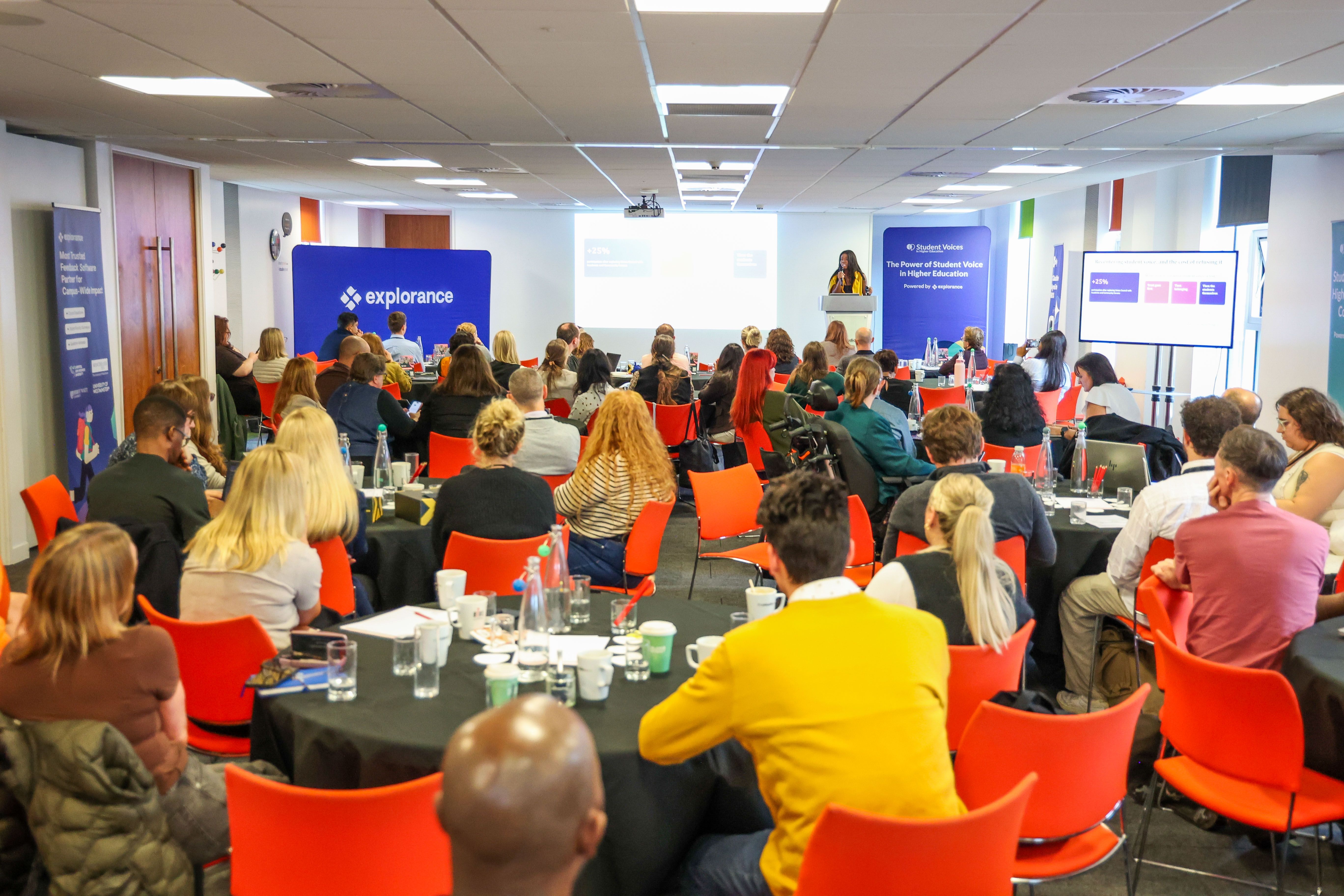
These questions shaped the fifth edition of Explorance's Student Voices in Higher Education Conference, held in Manchester on 14-15 October. Earlier editions are covered in key takeaways from the 2025 conference.
Bringing together university leaders, academics, student experience professionals and student representatives, the conference combined sector research with practical examples of partnership and institutional change.
Across the programme, a shared priority emerged: understanding students' experiences must lead to decisions and improvements they can recognise.
Here are some of the highlights:
Whose Table Is It? Recentering Student Voice for the Future of Higher Education
NUS England President Favour Samuel opened a packed conference programme with a challenge to how institutions understand representation: giving students a seat at the table does not automatically give them influence.
Drawing on experiences in South Africa and the UK, Favour explored the role of students' unions in supporting students, building community and ensuring their perspectives reach decision-makers.
The presentation emphasised that students' financial circumstances, housing, safety and access to support shape their ability to participate. Institutions need to consider whose voices are absent and what prevents them from being heard.
Students should be involved while decisions are being developed, with the support and information needed to contribute meaningfully.
As Favour's opening slide put it: "A seat is not a voice, and a voice that is heard but never carried through is not power."
Understanding the Demands of Student Surveying
Tom Lowe (University of Westminster) and Dr Stuart Sims (Arden University) explored findings from a QAA-funded audit of student representation and voice practices, which received 97 responses from 78 higher education institutions.
Their presentation examined approaches to module and course evaluation, alongside the wider demands placed on students through surveys, consultations, representation and partnership activities.
82% of respondents are conducting course or module level surveys and a single survey per module was the most common approach, but practices varied considerably. The discussion encouraged delegates to look beyond individual departmental activities and consider the cumulative effect of multiple requests for feedback.
Mapping those requests can help institutions identify duplication, coordinate timing and ask whether existing evidence could answer a question before launching another survey.
The emphasis was on purposeful engagement, supported by personal dialogue and a clearer understanding of students' time and attention.
Support, Community and Culture in Postgraduate Education
Advance HE's Shona Quinn drew on the Postgraduate Taught Experience Survey (PTES) and Postgraduate Research Experience Survey (PRES) to explore support, community and culture.
The findings highlighted differences both between taught and research students and within those groups. Part-time students were considerably less likely than full-time students to feel they had sufficient opportunities to interact with other postgraduates.
For example, 51% of part-time taught postgraduate respondents reported sufficient opportunities, compared with 71% of full-time respondents.
The presentation encouraged institutions to consider who can access the wider postgraduate experience and who may be missing out.
Support, relationships and community all contribute to postgraduate culture, but students encounter them differently. Understanding those differences helps institutions design opportunities for connection and give postgraduate voices appropriate attention.
Shattering Assumptions About Students' Needs Before Arrival
Jonathan Neves (Advance HE) and Dr Michelle Morgan (University of East London) shared findings from the first national Pre-Arrival Questionnaire (PAQ) pilot, covering both undergraduate and taught postgraduate students.
The presentation drew on 5,548 undergraduate responses from 15 institutions and 2,285 postgraduate responses from 13 institutions, exploring motivations, previous learning experiences, wellbeing, technology and anticipated work commitments.
Findings challenged assumptions about incoming students. In total, 71% of postgraduate respondents had not visited their chosen university before starting, while more students disclosed a disability through the PAQ than through official university routes.
The emphasis was on using this knowledge to act earlier. Examples included the University of Portsmouth contacting students who intended to undertake paid work alongside their studies and UCEN Manchester reaching out to those identifying mental health, financial or disability support needs.
The session encouraged institutions to practically use insights gathered before arrival to shape induction, communication and support around the students that they actually welcome.
Recognising the Costs of Student Engagement
Ruth Burchell presented work by QAA's Student Strategic Advisory Committee examining the costs students face when contributing to quality and enhancement activities.
These extend beyond money. Participation can mean sacrificing study time, paid work, rest or family commitments, while inaccessible arrangements can create additional emotional and practical burdens.
Student contributions highlighted the importance of advance notice, clear expectations, accessible materials and flexible opportunities to participate.
The session also explored recognition and reward. Payment can help some students, while others need alternatives such as references, recognised experience or professional development opportunities.
The central question was whose perspectives institutions hear when only some students can afford the time, energy or expense of participating. Inclusive student voice requires opportunities designed around these different circumstances.
Strengthening Survey Participation
Among the Explorance presentations, Chief Marketing Officer Anastasia Tsimiklis shared findings from the Global Response Rates Tournament 2026.
Across 85 submissions, covering 762,206 survey respondents, the average response rate was 74.5%. Purposeful communication was cited in 92% of submissions, while 89% highlighted instructor or leader engagement and 79% used strategies focused on timing and frequency.
Case studies from the University of Sharjah, the University of Nevada, Las Vegas, and the University of Newcastle, Australia, illustrated how survey access and delivery can affect participation.
At Newcastle, the loss of Canvas integration introduced additional steps for students, and response rates declined, underlining the value of accessible surveys within familiar systems.
Closing the feedback loop was cited in only 11% of submissions, highlighting an opportunity for institutions to build trust by showing students how their feedback informs change.
To register to receive the full report, which launches in November, visit the Global Response Rates Tournament page.
Manchester's Next Chapter with Blue and MLY
Sarah Williams and Daniel Bayes explained how the University of Manchester is moving from establishing reliable survey delivery towards redesigning its feedback portfolio.
Their work is guided by four principles: purpose, timing, ownership and communication, with Explorance delivering "stronger delivery, clearer Insight."
"Blue has supported more accurate staff-unit data through local validation; timely, role-relevant reporting through automated release; and stronger in-session engagement through direct links and QR codes – less build effort creates capacity for flexible delivery, trend analysis and new pilots," Daniel said. "MLY has enabled faster analysis of qualitative feedback at institutional scale; clearer, actionable insight from free-text comments; and central oversight with local access and ownership – one supported approach to qualitative insight across the institution."
Building on these foundations, Manchester is testing a redesigned approach during 2026/27, ahead of launch and evaluation in 2027/28. Plans include shorter, earlier course unit surveys and broader programme-level insight.
The presentation encouraged institutions to work backwards from action: before asking a question, to establish who needs the answer, what they can do with it and how students will hear about the response.
What Happens After Students Speak?
Ursula McTaggart demonstrated how Ulster University uses Blue and MLY to connect qualitative feedback with curriculum enhancement.
Feedback now contributes to its Continuous Assurance of Quality Enhancement approach, supported by aggregated reporting, dashboards, trend analysis and action tracking.
In the School of Computing, survey scores and comments prompted staff discussions about inconsistent assessment feedback. Combining MLY analysis with staff-student committee evidence helped colleagues agree on a structure for feedback and rubrics. A second example showed how feedback about laboratory demonstrators informed an induction workshop attended by 30 postgraduate demonstrators.
These examples illustrated how comments can explain the issues behind scores and support constructive staff conversations and, in the 2026 National Student Survey (NSS), Ulster's student voice scores increased from 76.1% to 79.7%, just 18 months after implementing Blue and MLY.
Ursula reflected: "Qualitative comments help explain what sits behind the scores. MLY makes it quicker to find relevant feedback and focus on particular subject areas. Bring comments, dashboard trends and other evidence into staff conversations to agree practical action. Follow up on that action and let students know what happened. Student voice matters when feedback informs decisions and leads to visible change."
Working Collaboratively to Build Student Success
Val Yates and Carolyn Moir explained how the University of Worcester uses student evidence and Design Thinking to explore opportunities for improvement.
Data from the Pre-Arrival Questionnaire provided a starting point for workshops involving academic colleagues and teams from accommodation, admissions, retention, libraries and student support.
Three workshops generated more than 40 ideas across themes including feeling valued, finance, relationships, study and wellbeing.
The approach brought together people whose knowledge might otherwise remain separate, helping to identify issues that no single team could fully understand.
Rather than treating data as evidence of blame or immediately reaching for a familiar solution, participants used it to explore possible explanations and responses.
The lesson was that evidence becomes more useful when combined with lived experience, diverse expertise and a shared commitment to follow-up.
From Student Voice to Career Readiness
Hull University Business School presented its Student Aspirations Insight Framework, developed over four years to help educators understand students' motivations, confidence and career ambitions.
The approach, detailed by Claire Carr, Dr Ryan Handley, Dr Thomas Hoyland and Adam Pearce-Craik, combines reflective narratives with quantitative indicators, drawing on work with approximately 150 first-year students annually through the Developing Self & Others module.
Students' reflections reveal different expectations of university, understandings of success and levels of certainty about future careers. These insights can inform curriculum design, academic advising, employability activities and wider development opportunities.
The framework supports understanding without assigning fixed labels to individuals. Students can express several motivations at once, and their aspirations may change.
Programme teams can make better use of the reflective evidence students already produce to connect educational experiences with students' developing goals.
Student Voice by Design
Dr Rod Brazier introduced Adaptive Chunked Experiential Learning (ACEL), an approach developed at the International Humanitarian College of London.
ACEL combines manageable learning cycles with applied activities, flexible assessment, regular feedback and structured reflection. Coaching and mentoring are designed to help students make informed choices and act on feedback.
The presentation distinguished student voice – expressing experience and influencing decisions – from learner agency, through which students make choices about their own learning.
A practical example considered a student unable to join a live discussion because of shift work. Providing a written or audio route could enable participation, followed by a check on whether that alternative worked.
Delegates were encouraged to identify one recurring activity where students could influence a decision, with a named educator, a clear timescale for responding and subsequent evaluation.
Partnership in Strategy and Learning Design
Two connected sessions explored how partnership can shape both institutional strategy and students' learning experiences.
In "Power in Partnership", Professor Claire Hamshire, Poppy McLean-Inglis and Rebecca Turton presented Oxford Brookes University's collaborative approach to student voice strategy.
They described a university-wide, iterative process involving an annual plan and continuing opportunities for co-design. Before choosing an engagement method, institutions should establish what decision is being made, who is affected and whose experiences need to be understood.
The presentation also recognised societies, networks and campaign groups as important sources of student expertise, alongside formal representatives.
In "Embedding Professional Literacies and Work Readiness Through Student-Led Insight", Professor Lindsay Williams and Professor Hamshire from Oxford Brookes joined Dr Deborah O'Connor from Manchester Metropolitan University to explore how these principles apply to authentic learning.
Examples included simulation, reflective practice and live-client projects, with student feedback informing their design, delivery and support.
Together, the sessions demonstrated how trust and shared influence can connect strategic decisions with everyday learning, helping students develop professional skills and articulate the value of their experiences.
Connecting Peer Insight with Structured Representation
Manchester Metropolitan University also shared complementary approaches to hearing students' experiences and turning them into action.
Dr Araida Hidalgo-Bastida and Jac Fossett explored how Peer Guides hear concerns that formal feedback mechanisms may miss. Students may feel more comfortable speaking with peers, particularly when unsure whether an issue is significant or where to raise it.
Through repeated, trusted conversations, Peer Guides can identify recurring questions and contribute insight to staff learning, employability panels and discussions about personal tutoring, assessment and support.
Jamal Majid and Vicki Markham then highlighted Manchester Fashion Institute's structured approach to representation. Student representatives help explain feedback, gather views, agree priorities with cohorts and bring issues to Student Educational Leads.
Dedicated time within teaching sessions and consistent communication make the process visible, with agreed actions communicated back to students.
Across both presentations, students contributed to improvement while developing their own skills, including communication, critical evaluation and information gathering. Clear responsibilities and visible responses help sustain that involvement.
Testing a Course-Level Alternative to Module Evaluation
Dr Richard Telling presented Sheffield Hallam University's pilot of a Course-Level Evaluation Questionnaire across three schools.
The approach aimed to capture the whole course experience, reduce survey fatigue and generate useful evidence through shorter, more focused questionnaires.
The findings offered an honest account of the challenges. Course-level feedback provided useful insight and aligned with other quality processes, but low response rates limited confidence that the findings were representative. Some comments were difficult to attribute to particular modules or translate into specific actions.
A central tension emerged between evaluating the overall course and maintaining clear ownership of improvements at module level.
The pilot did not achieve all its aims. Its value lay in testing assumptions and informing subsequent decisions, with schools and institutes gaining greater autonomy over appropriate student voice activities from September 2026.
Rebuilding a Learning Community
Dr Rhiânan Ellis shared the University of Sheffield School of Psychology's work to strengthen community, trust and student voice within a large undergraduate cohort.
An initial survey of 141 first-year students explored what a good learning community meant to them and where their experience could improve. Students particularly valued shared academic interests, collaboration, mutual respect and opportunities to interact.
Responses informed activities including a study-buddy scheme, a research fair, film nights, newsletters and a community library. Wider work strengthened student-staff committees and made responses to feedback easier to follow through summary videos and action trackers.
The presentation reported an increase in NSS student voice positivity from 50% in 2022 to 93% in 2026, alongside a rise from 107th to second nationally in the subject area.
The work illustrated the sustained effort involved in building relationships and making change visible.
From Policy to Inclusive Practice
Chi-Wang Edgar Lee and Rajat Shah presented the University of Westminster's embedded EDI School Champion model.
The approach connects institutional priorities with local student experience through student champions, academic EDI leads, mentoring and opportunities for dialogue with senior leaders.
Examples demonstrated how student-led inquiry can inform specific responses. In Media and Communication, interviews with course representatives identified barriers to belonging and informed accessible film nights. In Law, a student champion identified difficulties affecting disabled students, contributing to support networks, guidance and accessibility initiatives.
The presentation emphasised the importance of connecting student-led activity with governance and evaluation.
Giving students structured support and routes to influence can help institutions move from broad commitments on inclusion to changes that address the experiences of particular communities.
Being, Belonging, Becoming
Professor Harriet Dunbar-Morris from South East Technological University (SETU) explored how the Being, Belonging, Becoming framework can help institutions understand students' experiences and identify priorities for action.
The framework has been applied at the University of Portsmouth, refined at the University of Buckingham and introduced in a new institutional context at SETU.
SETU's first university-wide survey gathered 2,128 responses in February-March 2025. While 63% of respondents felt they belonged, 35% had seriously considered withdrawal. Making friends emerged as the most frequently reported factor supporting students.
The presentation advocated a whole-university approach to nurturing belonging throughout the student lifecycle, connecting curriculum, academic support and student services through partnership and evidence.
An Explorance-supported Being, Belonging, Becoming Survey Pilot for 2026-28 aims to build a shared evidence base, enabling institutions to benchmark experiences through institution-wide survey programmes, identify wider patterns and take targeted action.
Student Unions: Driving Change, Shaping Voices
Chaired by Tom Lowe, the closing panel brought together Alicia Cartwright (University of Lancashire Students' Union), Lucy Hart (Leeds University Union) and Tobenna Ndukwe (University of Salford Students' Union).
The discussion emphasised that students are individuals with different circumstances and priorities. Listening effectively means tailoring engagement and communication to different groups, recognising that the student experience extends beyond academic study.
Panellists challenged the idea that closing the feedback loop depends on resolving every issue. Students also need updates when change takes time, including honest explanations of what cannot happen yet and why.
The discussion highlighted the limitations of relying on final-year NSS feedback alone, stressing the importance of earlier opportunities to understand experiences and respond.
The central message was to involve students early enough to shape decisions through co-creation, explain the benefits of participation and show how their contributions influence change.
Phil is a specialist PR, communications and stakeholder engagement consultant with 25 years’ experience in both in-house and consultancy roles. He supports universities and schools, as well as commercial organizations targeting the education sector, to support their profile, reputation and business development objectives.
Related Articles





Learn more about Explorance's products, solutions, and the company.

